Tuesday, March 29, 2011

Liberian Living: Progress in my Heart

I know it’s been a minute since you’ve received a personal blog update from me, but I do hope you’ve been following the Mayor’s blog to get a glimpse at what I’ve been up to. I currently work in the hardest working office in Liberia, and that leaves very little time to author my personal experiences, but you know my mind has been overflowing with good things about being home.


Me, Mayor, Desmond

Check out what's happening in Monrovia here. Visit my new little pride and joy.

The very same day I got my job, I got a car. It was not just any car either. It was a Mercedes. This Mercedes was older, so it’s not like I was driving around Monrovia in a flashy manner but it was still enough car to make the police think I was wealthy enough to pull over for foolishness. The reason a Mercedes in Liberia is key for me is because my grandfathers drove Mercedes cars when they lived here. When I got mine, it felt suited perfectly for me. I could never bring myself to park it in the car port at my grandpa’s house because I believe that it’s still where his car should be. I can only imagine how things would have been had there been no war. I would have seen my grandpa in his Mercedes, going to and from his company, rather than simply hearing about his legacy. This morning I cried a bit as I brushed my teeth in his bathroom. I looked in that same mirror he looked in thousands of times while he shaved for work. To be in Liberia without my grandfather is surely a sore feeling for me. Everyday I have to talk myself out of tears.


Before

Butmy grandfathers are protecting me. One week after I got my car, my boyfriend and I had a car accident that could have been horrible. I was asleep in the back seat with my body stretched out and I heard someone whisper, “hold on tight.” As the car flipped several times we were able to emerge with our faith and bodies intact. Both my grandfathers were Mercedes fans, and although one passed away in the 70s behind the wheel, I was blessed and protected this month. Clearly someone thinks I’ve still got a large job to do here in Liberia.


Praise God

The worse part of the accident was going to JFK Hospital afterward. The way people were strewn about the emergency ward in any kind of way they could fit. Men laid naked with their legs open on the beds and on the cold floor next to puddles of urine. The women laid in beds with their clothes off, sweating, trying to cover what they could. The rats that scurried by the check in desk were the size of the children who were still begging for money and attention. This is the emergency hospital in Liberia, and had we needed plenty of attention, we surely would have died.

The organization called HEARTT, Inc was in town that same day to host an event at Monrovia City Hall. Dr. Sirleaf from HEARTT’s board checked us out later the next day. When we told him about our experience at the hospital he partners with, he wasn’t surprised. He simply reiterated how important it is that people invest in healthcare for Liberia. After my trauma in the trauma room, he couldn’t be more right.

Translations for this week:
Seree – Another word meaning “of America.” Being that I am “of America” I hear all the words that have to do with my upbringing. “Yah mayor’s office full a so so seree girls,” means “The Mayor’s office has plenty of American girls.”

You pa – A phrase that usually means someone is about to tell you about yourself. It seems to be short for “your part of problem,” which is pretty much stated when people tell you about your flaws. “You pa you like too much street business,” pretty much means “you like going out too much.”

Women as a Commodity (my tough story for the week):
One of the themes for the last class I took on campus was ‘commodification’ and it is here in living color with women as an affordable, common good. I work around many women who were here during the war and the stories are just awful. One, Angeline, had a mulatto sister before the war. Her father had a fair skinned daughter by a Peace Corp worker in Maryland County, Liberia. Angeline explained that she always ran from the war because Prince Johnson killed her pa, and raped her sister until she died. In her mind, war killed her family so she was literally running for her life. As the story goes, Prince Johnson always had a thing for the fair-skinned “Conga” women, meaning women whose ancestors are former US slaves and therefore were mixed with Caucasian blood somewhere down the line. They say every time he saw a Conga woman, she had to be his. I think about my beautiful sisters and just cringe at the thought. Women were victims and weapons in the war here, and ultimately it was women who caused the fighting to cease. I still cannot watch ‘Pray the Devil Back to Hell’ because the story is too real. For right now, I know there was a war here because everyday I work to clean it up. But to see footage will make it too real for me and I don’t think I can experience all of that.

Another co-worker talked about when she was 13 and a general came to her mom and said, "that’s the one I want. I will be back for her tonight." Her ma told the general that her daughter was a small girl and couldn’t possibly go with him. He said “big girl like that? She will be just fine.” After that she had to stay away from her town for almost a week until the coast was clear. When she was old enough she got a job at the Royal Hotel in Sinkor, and whenever people said “government officials are here,” she would hide in the back storeroom until they left. She didn’t want anyone to want her, “because one will want you, take you out, then another will see you and take you from him. Before you know it they have all passed you around whether you want them or not until they find the next red girl to take your place.”

These days, women still have a cost, the fare is just handled differently. I work in the Mayor’s office and every Lebanese man that comes through the door has asked for my phone number when the Mayor looks away. They offer money right there in the office with huge wedding bands on their fingers. Some say “don’t be scared,” or “we will be friends, I will help you,” as if associating with them is something I have no choice but to do. It’s hard for me to see the foreign businessmen as people whose industries can build my country up while they still prey on my Liberian sisters. A woman who makes $100USD a month would at least consider the option of dating these men. During the war it could keep her fed. Now, it could still just keep her fed. There are some very tough decisions to make here.

The magic words used by NGOs to gain funding these days are girls, women, empowerment, and technology. Any combination of these will earn your group a piece of someone’s budget this quarter. President Johnson-Sirleaf is so tickled by a conversation she had earlier this month with a boy who wanted to be a doctor, a lawyer, and a businessman. She asked him why he didn’t want to be president, and he exclaimed ‘that’s a woman’s job.’ The problem here is this: women have been misused for so long in our history that we need to take measures to level the playing field. However, if we are not careful we will have a society of prosperous women and incompatible, corrupt men to stand beside them. I really enjoyed the photos from International Women’s Day and Emma Thompson’s recent visit to Liberia. The two accounts really spell out what’s going on in here better than I ever could.


Girls at Ricks Institute hanging out at recess.

What Liberia Needs is You

Many people ask what they can do to help the situation here and I LOVE that you feel so engaged. Liberia really needs hustlers. There’s a lazy way of life here. People take too long to do anything, make money only for themselves, and few try to make an impact on Liberia as a whole with their actions. There is so much “Liberia for self” going on that even the NGOs are money makers. My professor just alerted me that the Carter Center has said their job is done in Liberia, so they’re ready to ship back to Atlanta. Liberia is far from better right now and there is always work to be done. With all the world’s crises, it’s been easy to forget about all the other people in need, but I’m glad there are like-minded people like you who still need ways to help.

Desmond is having an international college fair at city hall from June 20-24. We need schools present! Please send me an email if you have questions on how you can contribute. itsarchel@gmail.com

I am starting a summer reading program as my birthday present to myself at the end of May. I need children’s books, coloring books, crayons, etc. Again, email me! itsarchel@gmail.com

We are having issues with the school for which we would have referred potential teachers to work, however if teaching here is something that may interest you, please email me! itsarchel@gmail.com.

Basically, I’m risking unwanted emails in the hopes that something will call you to help the kids of Liberia. Below is the formal request for books for my summer reading program:

My beautiful home country of Liberia needs a lot of help in many different ways, but the first challenge that needs to be addressed is education. Without reading and writing skills, our children cannot hold positions to run our country in the future. 14 years of civil war has ruined our once thriving educational system, and we can take very simple steps to make it better. I believe the first step in recovery would be to have books the children can read.

When I was little, I had every book in the world. At least it felt that way. I was able to read and escape to different worlds, learn life lessons, and relate to fictional children my age through words and pictures. Nancy Drew made me want to be a detective, and the Babysitter’s Club made me excited to get my first job watching neighborhood children. I wanted to be something, and I could articulate what I wanted to be because I had access to a vocabulary I could use limitlessly.

As communications is my job in the Mayor of Monrovia’s Office, I would like to initiate a summer reading program at an orphanage my mother supports. The problem is, I haven’t got any books to do so with. I’ve not seen anything sturdier than a Newsweek magazine or more children focused than a cereal box in Liberia. Even if I did find a children’s book, I’m certain the majority of children couldn’t afford to purchase one. I want to teach kids to read, and I think everyone should have the chance to enjoy children’s literature.

Someone in the Liberian Orphan Education Project shared with me a story of their visit to this particular orphanage. A group of girls were sitting together on the ground with one sheet from a coloring book and one piece of a red crayon between them. The girls would take turns shading a part of the picture, and then passing the red shaving and paper to the next girl and so on and so forth until the picture was all colored in. I always had a favorite color in the crayon box. And when the crayon would break, I would simply throw it away and get a new one. My coloring books had tons of colors. I could never choose which page was my favorite to start with! I know that because I had coloring books, crayons, and reading books my mind had no bounds. Please help me expand the creativity of a young Liberian child. The orphans could be the next rebel leaders and armed robbers, but a small intervention could make them the democratically elected president that influences other countries to seek better for their children. Here is the change we wish to see in the world.

Kids at Ricks Institute at recess

This weekend I perform "Still I Rise" by Maya Angelou for an UNMIL (United Nations Mission in Liberia) women's concert. I don't really know how I ended up doing this, but look forward to updates on women and fashion!

Sunday, February 27, 2011

Liberian Living: The Bare Necessities

It would be wrong for me to continue to use the internet at Rozi's and not explain why I cannot get enough of this restaurant. Allow my pictures to do the talking.


The bottom line is I've been sitting at her buffet brunch all day. I eat a typical Liberian breakfast of casava (or yucca for South American readers) and fish gravy, type a little bit, get back in line for potato greens, type a little more, and finish with the world famous lemon tarts. Watch out for the croissants, they're better than the ones I had in France! Thank Rozi's on Airfield Shortcut in Sinkor for my illustrated posts.


No hangovers in Liberia:

This is a soursop plant. If you do a little research you will find that this member of the pawpaw family grows where it's hot and tropical, including Liberia. What you won't find out without asking around is that it is an amazing hangover cure. The fruit itself tastes like a tropical Starburst candy without the artificial sugar. A friend of mine explained how he drank liquor in excess, ate some of this fruit in the same evening, and woke up the next day prepared to take on the world again. Earlier in 2010, Time Magazine released an article on the hangover benefits of coconut water. If you refer to my first post in Liberia, you can see why there are too many options of relief for anyone to get sick due to too much alcohol in this country.

For the literary minds:

I love reading about Liberia when I cannot be here. If someone's coming in April however I hold your foot, you must bring me a copy of And Still Peace Did Not Come: A Memoir of Reconciliation by Agnes Kamara- Umunna and Emily Holland. It's available for pre-order right now on Amazon.com. All I've had to feed me is this excerpt, and indeed I want more.

What I want to say is this: For too long, my country, my Liberia, was a difficult place to love. The war came and took everything that was good and loving and peaceful. People grew older and older and still peace did not come. But it's different now. The sorrow is subsiding, and individuals are making peace with the past. A woman is president. Children go to school wearing pressed uniforms, satchels on their heads. "Did you finish your homework?" their mommies call after them, steadying their own buckets of water and bundles of wood. After school, boys shoo cows from the fields to make room for soccer matches. Girls skip rope under trees that look like elephant legs. They are not oblivious to what came before. Still, most of the time they are doing what children should be doing, and that is progress.
Now for those of you with middle school aged kids, I think it would be cool for them to read Mamba Point by Kurtis Scaletta. It's a coming of age novel about a 12-yr old boy whose father works for the US Embassy in Liberia during the 1980s. I've not been able to read it for myself, but I'm thirsty for reviews! It must be a nice way to get your 8th graders familiar with my home, pre-war.


Translations:
'I hold your foot' :
I beg you; a very strong way to say please (pronounced ah-hole-ya-foot in Liberian English)
Bonus translation
'You got best' : I'm at fault; I'm sorry (pronounced you-gah-bes in Liberian English)
I had to learn the last one while I was here. Someone told me "you got best" and I didn't even know how to respond! Clearly I'm learning and observing everyday! Add these to your Liberian dictionary and use as needed!


In my backyard:
I got my first taste of a pawpaw this week. I was so excited! Then I tasted it and decided I like it better in the pawpaw pies Rozi makes at her restaurant. It needs sugar. The houseboy says my grandmother used to squeeze a lime on top of the fruit before eating it. The texture of the pawpaw is soft like a banana though it looks similar to a melon. It slices very easily with a knife. Plain and hot like it was, it left a lot to be desired, but what grows from your backyard?? I'm still waiting for my plums!!


Cut it when it's green and yellow like this. Compare to my previous post when the pawpaw was completely green.


Scoop out the seeds and you can eat it easily with a spoon.


The elements of a luxurious bucket bath:
Fact of the matter is that most Liberians do not have running water in their homes. Sure, foreigners and many of the Liberian elite class can take showers, but as I showed you in the last blog post most Liberians make do with water pumped right from the ground. Below I've included a step by step guide on how to take the most luxurious bucket bath of your life.

You will need:
A bucket. This is indeed what it sounds like. You will use water from the bucket to bathe. You also need a small cup with the handle. Both of these are easily found in the streets of Waterside (Waterside is like an outdoor Walmart in Monrovia. Whatever you need they've got it).


And I don't know why they use this tye dye pattern on all the buckets, but it's pretty typical.
You also need the houseboy to fill the large drum of water.


For sanitation, use an antiseptic like dettol.


How to do it:
Have the houseboy boil a pot full of water for you. Pour that into the larger tye dye bucket. Fill the rest with cool water from the large drum. Use the smaller tye dye cup to dip water from the drum into your larger tye dye bucket. We encourage practicality.

Pour two cap fulls of Dettol into your warm water mixture. Now we're sanitary.

I hope you're adult enough to know how to bathe when the water is in front of you. If ever I have to take a bucket bath, which happens sometimes, I put the bucket in the bathtub. If you drive through Monrovia however, you can see lower income families bathing children in the dust by their house so the water can runoff. TIP: Don't put your soap in the large bucket because that is your rinse water. That would be counter-productive. As you need to wet your body, dip the small tye dye cup into the larger tye dye bucket and pour as needed.

Bucket bathing is indeed an experience, and you've got to work to be clean. Nothing beats a cold shower in hot Liberia, but it's always nice to understand how the other 90% lives and bathes.

On a tougher note:

Each time I've been to a foreign-owned restaurant, I've seen a young Liberian girl dining with and doting on an older foreign man. The prostitution in Liberia is too plentiful, and it makes me so ashamed. The girls are no older than my baby sisters, and they prostitute for school fees and as a means to sustain themselves. My boyfriend saw a young girl with barrettes in her hair dining with the father of her newborn child. I would really like to encourage everyone to refer to my mom's news package here and really try to make a proper education within reach for our young women. If we don't invest in our people, we will raise a country full of houseboys and drivers.

Truth be told, I'm not too convinced about the quality of education the children are receiving here anyway. Baby Archel, the daughter of my father's employee, is supposed to be reading now, but she hardly knows how to speak proper English. Her mother doesn't help her read but I don't believe she knows how to read well herself. Even if she did, I haven't been able to find any children's books to read with her. The education gap is so large between Liberian children and children in the states that I wonder if these kids ever be able to lead their own country. Think about how many reading and coloring books you had as a child. Baby Archel has none at all. As I make my living talking and writing, baby Archel gets nervous when people ask her questions and cannot open her mouth to speak audibly when asked a question. This all comes full circle. Will she be able to demand a fair salary for whatever work she decides to do in the future? Will her school equip her to properly fill out a job application? Can Liberia train leaders with this educational structure, or are the young girls in restaurants prostituting for school that cannot properly advance them?

I've got a short Liberian wish list. If you come or know of anyone making their way here, I beg you to please send children's books. I will soon be starting to read to baby Archel and other Kindergartners of Monrovia as I try to help my people catch up. Even one book will help a child develop proper phonetic skills. I will see to that personally.

Love and kisses to all of you from across the Atlantic Ocean. I will be going out with the Carter Center Liberia mid-March! It's not a paid job (yes I'm still looking for one), but I'm still trying to hold NGO's accountable for their work here.

Tuesday, February 22, 2011

Liberian Living: The Odds and Beginnings of Things

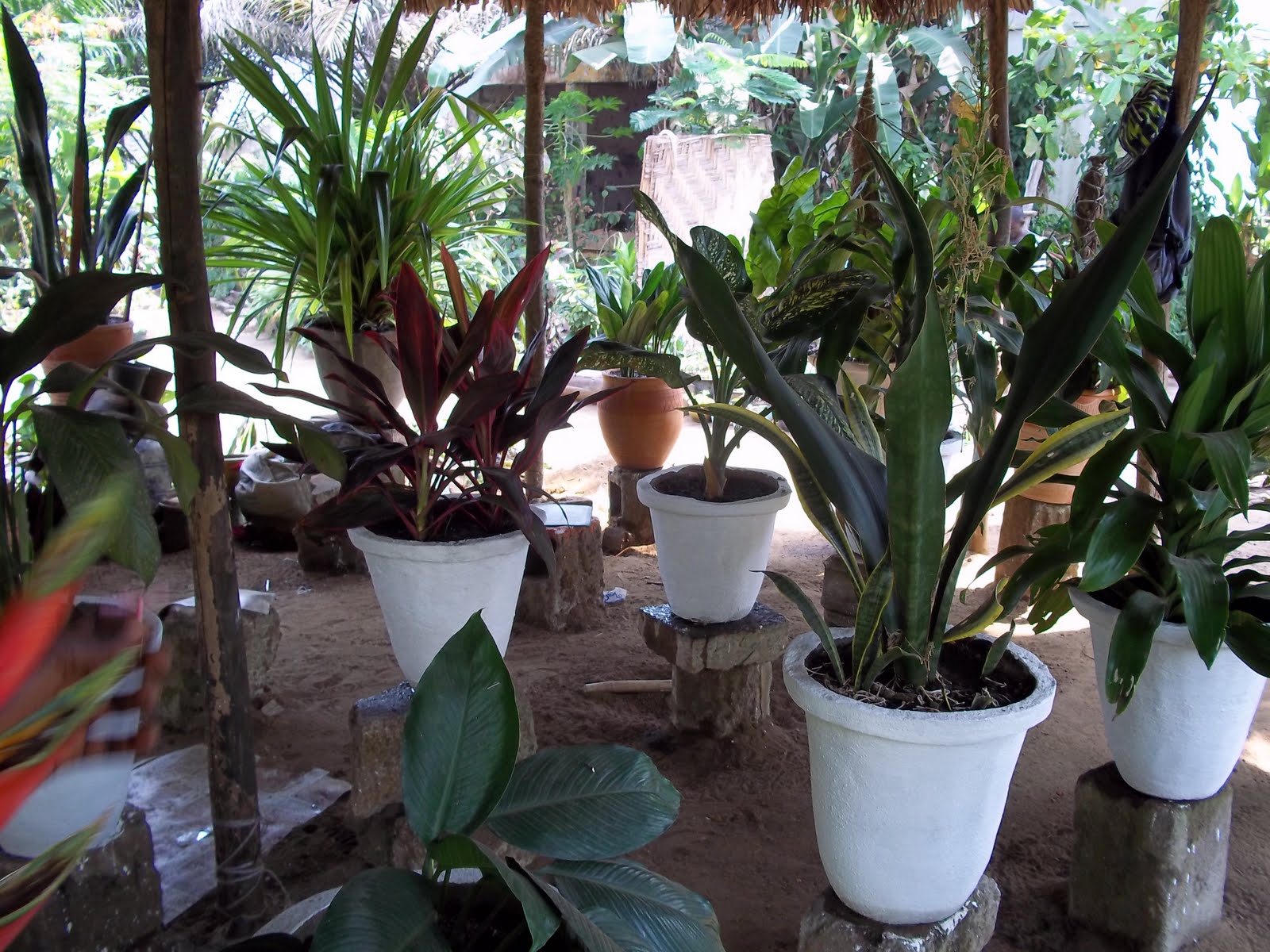
I was walking down Tubman Blvd in Sinkor and ran across the most beautiful flower garden. I had to stop and take pictures. If you live in Atlanta, a flower garden in Sinkor is like a park by Lenox Mall. Sure, you can put one there, but it would be an out of place delight.


This is Ben of the Coop-Ben Flower Garden. Cooper is his brother. Ben is most proud of the orchids they grow. He explained that 20 different species of orchids grow in Liberia. Ben was excited to show off all he knew about the nursery. Unfortunately there weren't any roses for Valentine's Day, but he makes friends in hopes that they will bring him seeds he can cultivate. In the above photo, Ben is in front of the palava hut. A palava hut is defined as a meeting place where people discuss and resolve issues out of the court system. It is a place where people can talk all the news, and more loosely gossip. Palava = informative talk in simple terms.


This is ben and his passion flower, he says.


Please don't tell Desmond that I posted a picture of him pumping water from a well, but I wanted you to see how people get fresh water if they don't have indoor plumbing. I still don't advise you to drink it, or even use it to brush your teeth initially, but for bathing and washing clothes, you have to pump from the community well. Often times, you can see a lot of children pumping the water in pails to take home. This is a reality for most Liberians, but also many people around the world. Now I'm very uppity and have pumped water for the arm workout it provides once or twice, but fortunately water runs in my house in the daytime, and the houseboy brings the well water before he goes to school in case I need it. *Remember the term houseboy from last week.


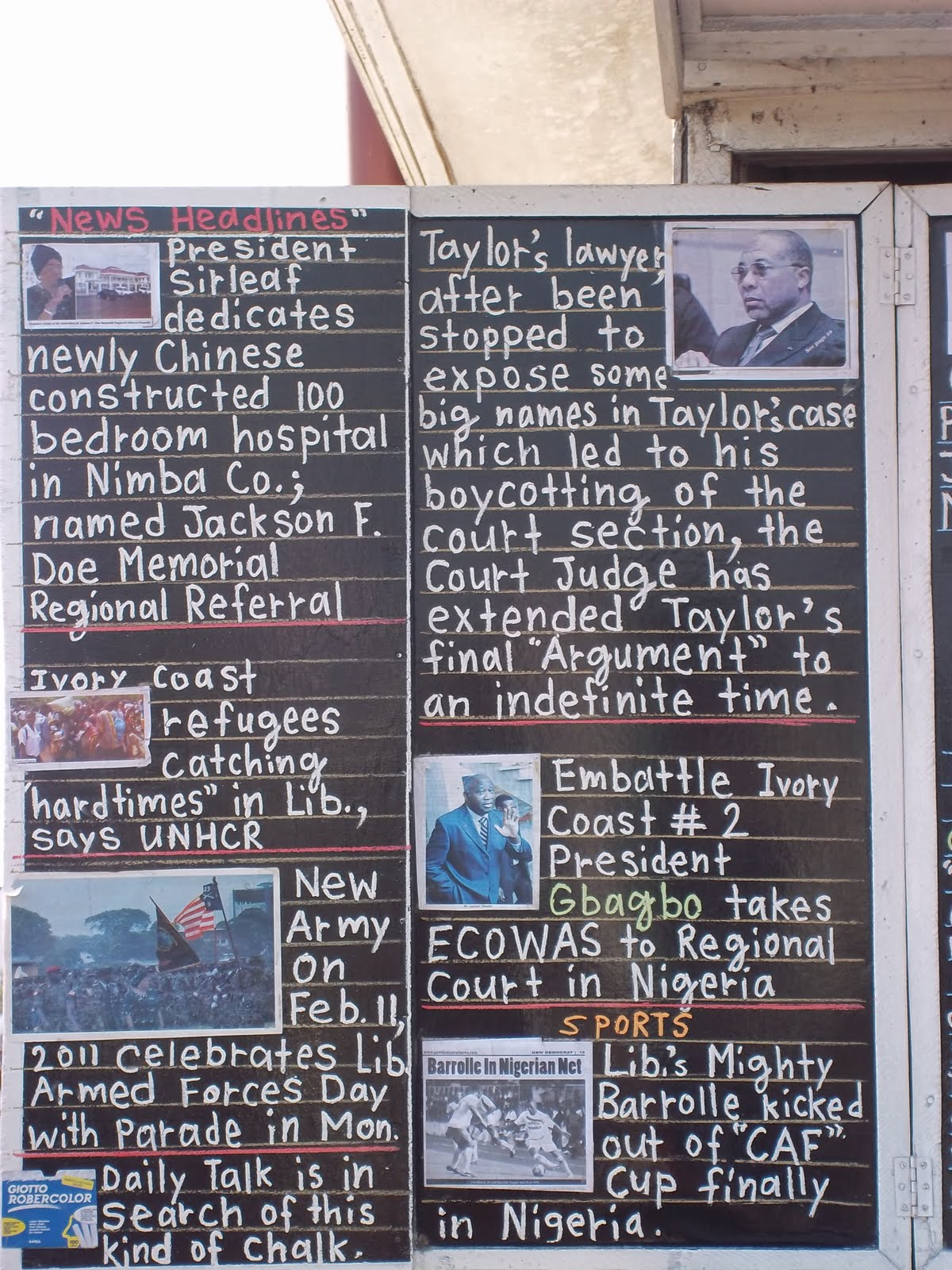
Being the media enthusiast that I am, I found this news board across from Coop-Ben's Flower Garden in Sinkor. Whoever is in charge of updating it does so everyday, and the people read it as they pass by. The news on this chalkboard is less sensational than the newspaper, and people are eager to get the headlines for free with this method.


You will see the phrase "catching hard times" on this post. That is a common Liberian phrase that means exactly as it says. Add it to your Liberian dictionary and use accordingly. Can't pay bills this month? Tell your landlord you're "catching hard times." School got you down? Yes, you are also "catching hard times."


On a more serious note:

The hardest part about being in Liberia is seeing the foreign influence that isn't exactly foreign aid. It seems like the best get-rich-quick scheme of this day and country is to start a non profit, non governmental organization with great proposals and would-be plans for a better Liberia. All I know is that peace and rebuilding is turning into a profitable industry in a country where a little money could go very far.

I first visited the CARE Office in Liberia to see what they were up to. I was optimistic because this NGO is headquartered in Atlanta and the CEO recently received an award from Georgia Tech for her international work, etc. Basically my findings for CARE Liberia are as follows:

I spoke with one man about the ongoing projects in Liberia. He said there is an ongoing project on water and sanitation that gains a lot of funding from the Howard Buffet Foundation. Most of CARE Liberia's other projects are centered around food and income security, gaining funding from the European Union. The representative also said that they try to solicit funds from USAID, but currently that money is still pending approval. This representative was educated in the Ivory Coast, which I was delighted to discover and asked about the efforts for Ivory Coast refugees. He said CARE has a global emergency coordination team, and they are currently in Nimba County, Liberia where they have reached 20-30 000 refugees at last count, and are distributing non food items like tents, blankets and buckets.

My fair assessment of our conversation is that nothing is really going on in Liberia, through this office at least. Understand that "ongoing project" means "whenever we feel like working on it" in Liberia, so there isn't much water being purified. The representative couldn't tell me exactly what they were working on at the present time. There was a lot of explanation of what they do at CARE, and less of what gets done in Liberia, if you understand what I'm saying.

Take for example the Ivorian refugees. There is a French speaking, Ivorian educated man right in Monrovia doing nothing at CARE, and he's not in Nimba County trying to assist with aid. He doesn't even know how many people they are helping. 10 000 is a large window of error in a country that should house first responders to crisis in the Ivory Coast. How many blankets do they have to hand out? Have they run out yet? These are more accurate ways to keep count of the activity. Truly, the emergency team is probably distributing materials to Liberians who want tents because they can't tell the difference between who has fled here with nothing from the Ivory Coast and who is a Liberian citizen in poverty. Many of the tribes are the same between the two countries, so a foreign responder probably cannot distinguish one African from the rest.

Disappointed, I visited the Carter Center in Mamba Point to find the same "whole lotta nothing" being done. The documents they gave me on the Liberian programs were outdated, and no one could tell me exactly what they do to help Liberians from day to day. I don't want to be unfair and say the Carter Center is an idle space as well, as they gave me the information for their project coordinator in hopes that I can really chat with him and maybe even go out on a task. As for now, I'm just unimpressed. I am writing a more in depth assessment of these findings, so let me know if you're interested in reading them. Even the UN, I'm convinced, is somewhat a scam, and I am by no means an extremist. I would just like to see Liberia become rich again, rather than people becoming rich off our need.

As I left the Carter Center, we drove along the most beautiful part of Mamba Point. The beach and water was perfect for a resort vacation. It was just covered in sewage. The smell of trash just hit you and blew with the ocean breeze. Then I saw a little girl drinking from a cup beside her mud home, and I didn't even want to think of where her drinking water came from. As we came back inland my uncle pointed at a gutted, looted, shell of a once beautiful home and said "there's your Godma Cheryl's house." I can picture her playing in that ocean when she was little... before it was a sewer. How unfortunate. All the things Liberians can have, stripped from war and sunk in poverty.

If NGO's spent less money on administrative costs and salaries, they could really fix that beautiful beach I saw today. I don't like to post ugly pictures of Liberia, so I didn't take any. A beach should never be a landfill and a non profit organization should be beneficial to our community. Alas, what should be and what is are two different things.

My next post will be fun, I promise. Four weeks back home has brought real life to the forefront.

Wednesday, February 16, 2011

Liberian Living: The Black and White of Print Media


Anyone who has read a Liberian newspaper is reminded immediately of an American tabloid from the grocery store checkout line. Large pictures draw attention to the often sensationalized headlines, and a reader cannot be sure what's fact and what's opinion when they read any content on the inside. The problems with accessing trustworthy news are plentiful because the root of the problem itself runs so deep.


First, newspapers are sold in traffic in the early morning. Kids walk between cars on the already congested Tubman Blvd to sell a newspaper for about 35LD (about 50cents USD). Picture yourself driving down the street and a large headline reads "I will run again" under a picture of former President Charles Taylor. You're going to want to buy that paper and see what on earth they're talking about. After you've purchased this paper, you notice the headline is simply a quote from the former footballer and current presidential candidate George Weah, but the newspaper has made a sale by pulling on your feelings, and each day every paper is in competition to earn your purchase. I buy the papers every so often because the job listings are always updated, which is convenient for an ex-patriot like myself.

I spoke about what I've seen with two Liberians I'm working on my non-governmental organization with, and we've come to several reasonings about the newspaper issue.

In the Charles Taylor era, journalists had to be picky about what they printed. The country was at war, and you didn't want to be on the wrong side of that. Fair enough.

These days, writers and editors make less than $200 a month, which isn't enough to pay any college educated journalists. It's not uncommon for a writer to only have a 9th grade education.

Last and most unfortunate, Liberians aren't reading at levels that encourage better newspaper content. The pictures and short words communicate all that a citizen may need in order to get their facts for the day. When I expressed that the CIA World Factbook lists the Liberian population as being 57.5% literate, my colleagues were surprised to say the least.

"Usually NGOs determine that number, but I've traveled extensively in Liberia and I must say most of our people are illiterate, and I mean many many more than half."

"They say 'if you want to hide it from Liberians, put it in black and white.'"

This leads to the larger problem of education. In many places, teachers aren't even high school graduates themselves. I plan to do a little digging on education before I do a formal report of it, but if you're interested in education in Liberia, click around the Liberian Orphan Education Project website. Our family friends, Beth and Emmalee, travel back and forth between Liberia and the states to train teachers and bring classroom supplies, and always pay for their trip themselves! Who knows, maybe one of the orphans they impact will reshape the newspapers I see everyday.

So what do we do for real news out here? Aljazeera is the best I've seen. If you only watch CNN, you're not hearing about most the wars being fought. Of course, BBC radio is present as well and has had great coverage on Egyptian affairs, but for local news? The bottom line is that there is much to be desired.

Being that we're right beside the Ivory Coast, you would think I would get a lot of news from that side, but you'd be mistaken. I've not met any Ivorians or been impacted by their unrest at all.


Now to my backyard:

The plums and pawpaws are developing nicely right over the house. I cannot wait for them to drop! Imagine, these are the trees in my backyard. In the states, I only had pinestraw!
I've told the houseboys that they are not allowed to eat anything that falls without checking with me first. They were eating all the pawpaws and then saying "sorry madam, they're not ripe yet." No more of that. I comin end that quick.

Translations:
plums: mangoes!!
Top picture.
pawpaws: papaya!! Bottom two pictures.
drop: when fruit becomes ripe and ready to eat. sometimes it simply falls from the tree, hence 'drop'
'I comin': 'I'm about to' or as southerners say 'I'm fixin' to.'
When said with more passion, it can mean 'I will.' Popular ways to use this can be 'I comin' go!' to signify that you are about to leave.
houseboys: workers of the household.
In our yard, we have one who lives on the property and another one who comes in the daytime to help out. The one who lives on the property is given accomodations beside the house but still on the estate, school fees, health care as much as he should need it, and an allowance. The one that comes in the day is simply given a monthly fee. Duties may include washing dishes, cleaning, dusting, and minding the gate to the house among other things. A Liberian estate can also have a cook, a washman (for clothing), and a watchman (for security), so the duties should not overlap.

I'm waving at you from across the Atlantic!

Wednesday, February 9, 2011

Liberian Living: The Fresh Coconut Experience


Now, I'm not usually a fan of 12 year olds with machetes, nor am I a fan of shredded coconut in the US, but I'm glad I didn't let my distaste for these things stop me from getting my hands on a fresh coconut when I took a trip to Robertsport this weekend. The boy in the picture above's name is Morris, and if I can get this video to load on this eternally slow Liberian internet, you can see how he was hacking away at the coconuts to get to the treat.

Update:: video here

For all other beach guests, he was selling one coconut for 40LD (Liberty Dollars). Since my good friend Tania is the self proclaimed president of his football (soccer) team, she requested he "dash" them for us.
Translations:
dash: free
If you ever go shopping and buy a lot of stuff, it's typical to believe you're owed something small as a dash. Think of it like they 'dash' the price off.

As of today 72LD=$1
That's right folks, no one in this country has change for a $20 bill. Trust me. It's a bit ridiculous.
Oh yes, the little boy is almost chopping his fingers off to earn about 60cents.


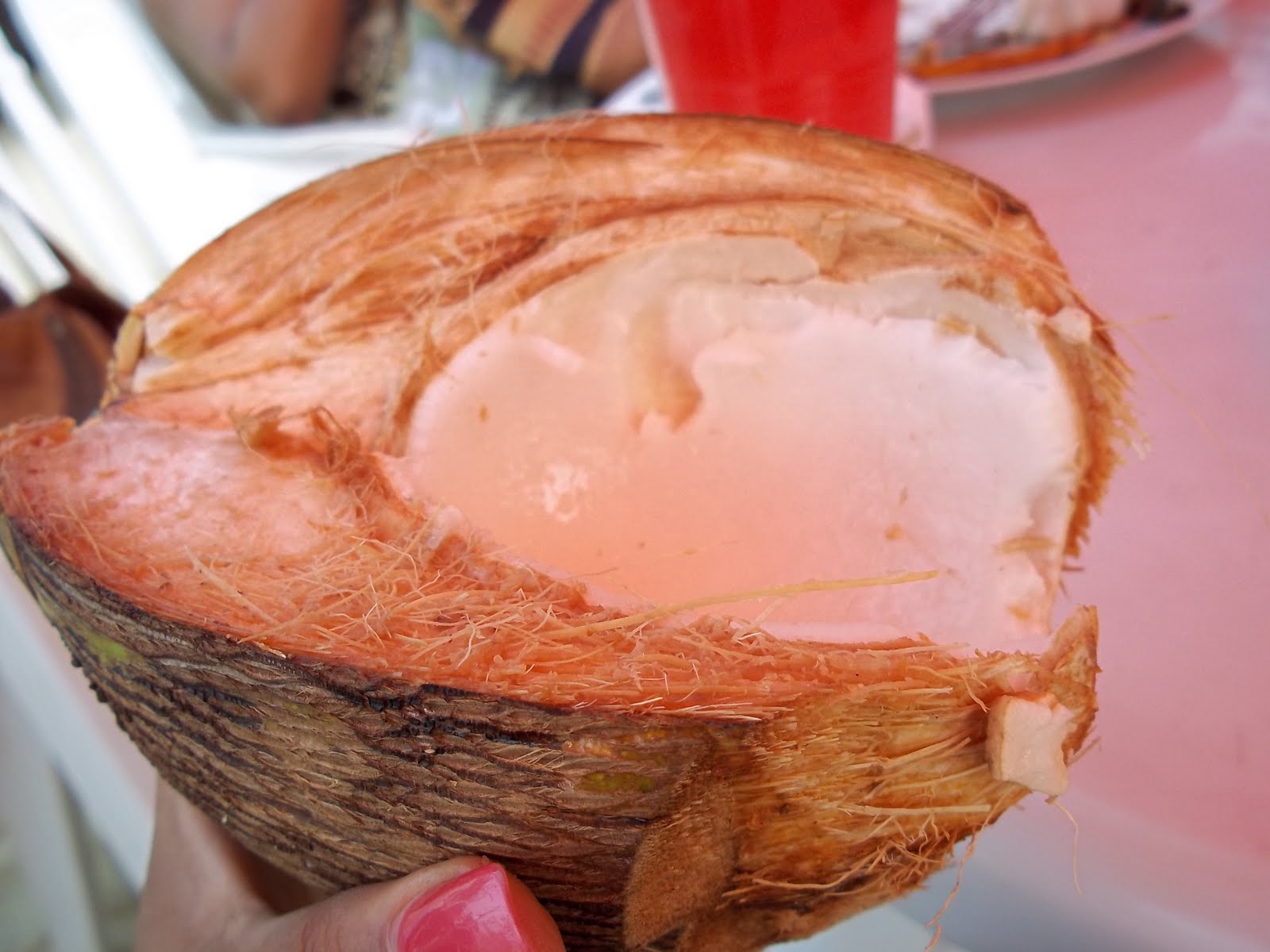
Anyway, this is what it looks like when he cracks the top. The coconut water inside is SO yummy. You drink it through the hole like a thermos. Unless you're kwee like me and pour it into a cup.

kwee (no one's really sure how to spell this word, so I spelled it phonetically for you): uppity; bourgeois; sometimes can mean 'American behaving.'


So once you're done drinking the water, the machete child will split the coconut in half for you to eat the meat. It taste NOTHING like shredded coconut in the baker's aisle of Kroger. It's delicious, but I can't describe what it taste like. Guess you'll have to come and try it for yourself!!


As it was taking me so long to use my acrylic nail to scrape the meat off the sides, I was finally informed that you are supposed to use the piece that came off the spout of the coconut to efficiently enjoy the fruit of the coast.

It worked a lot better that way.


Special thanks to Tania and her football team for the experience.


I've eaten barracuda fish and pepper sauce twice since I've been here. It's delish! So plump and practically boneless. The only problem is that it's a high mercury content fish, so you shouldn't eat it more than once a week, and pregnant women shouldn't eat it at all. Maybe that's why I've been sick for four days? What do you think?


Other Liberian delights:
Tides restaurant on Waterside. Post on this to come.
Rozi's NYLA Cafe off Airfield Shortcut. Get the lemon pie or chocolate cake.
Destination-liberia.com : my cousin's one stop tourism info center.

I'm waving at you across the Atlantic!!!

Sunday, January 16, 2011

No Words


I haven't really felt motivated to write recently.
Sometimes I think my words can't accurately communicate the ways I feel.

Overwhelmed? Yes. Blessed? Certainly. Liberated? Getting there.

I think I'm on the cusp of something great. I don't know what it is or what it will be, but man I feel it.

I graduated college and I am moving to Liberia to build my empire, yet all of this seems pale to the issues Africans continue to have as they try to transfer power through free election.

I've gotta do something more than host videos. I've got to create more than blog posts. There's a world full of people suffering to exist, and God put us here to thrive. This is my life, and I wasn't made for petty work. There's something grand over the horizon.

If God has me here, I must need it. More than that, I believe the world has readied me for its necessities as well.

I haven't been able to write because I don't have a conclusion. I don't have an ending for any of these thoughts. My mind just keeps shuffling with thoughts. I don't want to think anymore. I'm ready to just DO.